Guide · Blog Post
Cloudflare Agent Skills: All 22 Skills, What Each One Does, and How to Install Them
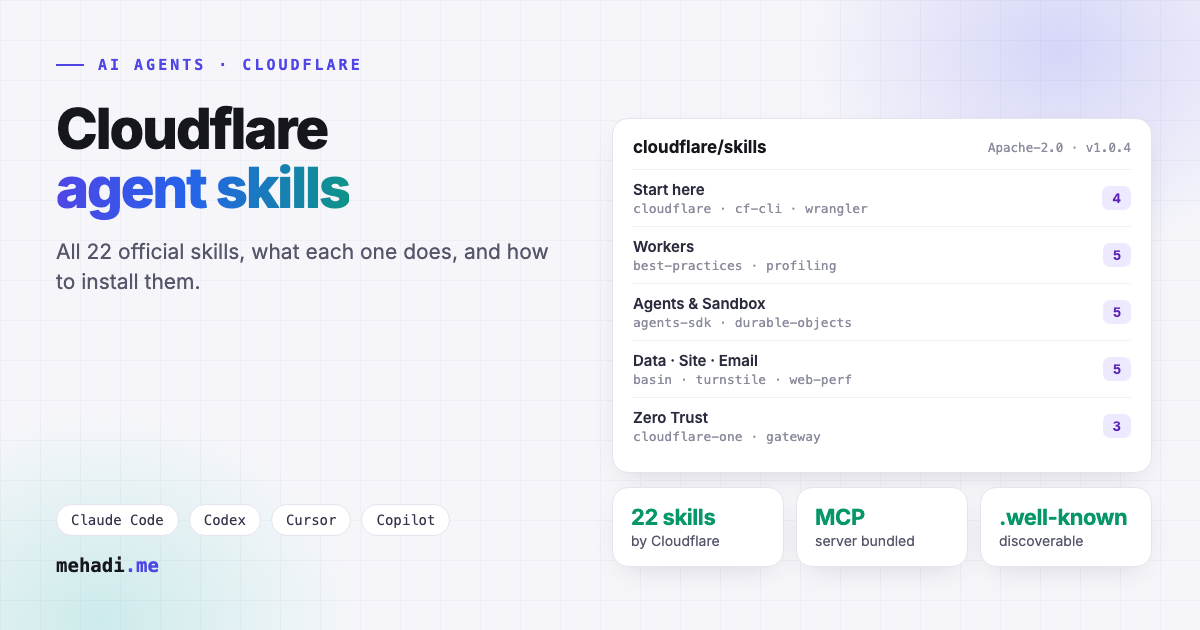
Ask a coding agent to build something on Cloudflare and it reaches for what it learned in training, which for a platform that ships this fast is often last year's API. Cloudflare's answer is a set of official Agent Skills: 22 small playbooks that tell an agent which product fits the job, which CLI to use, what good Workers code looks like, and where the current docs live. Here is every skill Cloudflare publishes, grouped by what it is for, how to install them in your agent, and which ones are worth turning on.
By Mehadi Hasan 9 min read
1. What Cloudflare actually published
Everything lives in one repository, cloudflare/skills, licensed Apache-2.0 and maintained by Cloudflare. As of November 17, 2026 it has about 3,400 GitHub stars and is updated often; the copy reviewed here was pushed the same day. It contains:
- 22 skills, each a folder with a
SKILL.mdin the open Agent Skills format, so the same files work across Claude Code, Codex, Cursor, Copilot, OpenCode, and other compatible agents. - A plugin (version 1.0.4) that installs the skills together with Cloudflare's main remote MCP server at
https://mcp.cloudflare.com/mcp, which gives the agent access to the Cloudflare API and current developer docs. - A Cursor rule for Workers projects that points at the same guidance.
Cloudflare also serves the same 22 skills from its developer docs site at developers.cloudflare.com/.well-known/agent-skills/, each as a downloadable archive with a SHA-256 digest. More on why that matters in section 5.
2. All 22 skills, grouped by job
The repo lists the skills in one flat table. Grouped by what you would use them for, they look like this:
Start here: choosing products and CLIs (4)
cloudflare
The router. Starts from what you are trying to build, maps it to Cloudflare products (Workers, D1, R2, Queues, Workflows, AI Search, and more), then loads the right skill or reference. Also triages Cloudflare error pages, 52x statuses, and 1xxx codes.
cf-cli
Finds and runs commands in Cloudflare's new cf CLI (in beta, with 2,900+ commands generated mostly from API schemas), and decides between cf and Wrangler for a project.
wrangler
Runs and troubleshoots Wrangler in projects that already have a wrangler.jsonc, .json, or .toml: local dev, previews, deploys, and resources like KV, R2, D1, Queues, and Workflows.
cloudflare-app-bootstrap
Gets a new or freshly cloned app to a working local request: bindings, secrets, seed data, and a real verification step.
Workers in production (5)
workers-best-practices
Writing and reviewing production Workers: current compatibility dates, logs and traces on, streaming instead of buffering, and a table of anti-patterns such as hardcoded secrets or work started without ctx.waitUntil().
workers-development
Local development and debugging with Local Explorer: reading and seeding binding data, traces, and logs.
workers-profiling
Profiling CPU and memory allocation in deployed Workers and Durable Objects, then turning the pprof output into fixes.
frameworks-on-cloudflare
Astro, SvelteKit, React Router, TanStack Start, Nuxt, Hono, and single-page apps on Workers, routed to each framework's own Workers guide.
nextjs-on-cloudflare
Next.js on Workers with vinext, which the router recommends over OpenNext for new projects.
Agents, state, and sandboxes (5)
agents-sdk
Building, debugging, or reviewing apps on Cloudflare's Agents SDK: state, scheduling, RPC, MCP servers, email, and streaming chat.
durable-objects
Stateful coordination such as chat rooms, games, and bookings, with RPC, SQLite storage, alarms, and WebSockets.
sandbox-next
Isolated Linux environments on the @cloudflare/sandbox@next 1.0 preview, recommended for new projects. It checks the package line before it writes any code.
sandbox-stable
The same for apps on the current stable @cloudflare/sandbox package.
sandbox-migrate-to-next
Porting a stable Sandbox app to the 1.0 preview, only when you ask for it.
Data pipelines (2)
basin
Analytics workflows with Basin Pipelines, Basin Catalog, and Basin SQL: streaming data into R2 Iceberg tables and querying it. It also catches requests that use the older Data Platform, Pipelines, or R2 SQL names.
k2
Durable event logs with K2 Streams: producing from Workers or HTTP and consuming through subscriptions.
Your site: bots, speed, and email (3)
turnstile-spin
Sets up, repairs, or migrates Turnstile bot verification end to end, including server-side Siteverify, with framework references for HTML, Next.js, Astro, SvelteKit, Hugo, and more. It drives bundled scripts that call Cloudflare's API.
web-perf
Audits Core Web Vitals (FCP, LCP, TBT, CLS), render-blocking resources, and network chains, using browser and performance tools such as Chrome DevTools MCP when available.
cloudflare-email-service
Implementing or troubleshooting Email Sending, Email Routing, and delivery configuration.
Zero Trust and networking (3)
cloudflare-one
Designing, configuring, troubleshooting, or reviewing Cloudflare One across Access, Gateway, WARP, Tunnel, WAN, DLP, CASB, and device posture, including service-token access for agents and other non-browser clients.
cloudflare-one-migrations
Assessments, policy mapping, gap analysis, and rollout plans for moving from Zscaler, Palo Alto, legacy VPN, or other SASE platforms to Cloudflare One.
gateway-workers
Writing and reviewing Workers invoked by the Forward action in Gateway HTTP policies.
3. How they are built, and why it matters
Reading the skills side by side, three design choices stand out. They are worth copying if you write skills for your own team.
- "Prefer retrieval over pre-training." Most skills open by telling the agent that its knowledge of the API may be outdated, then list the exact documentation pages to fetch. The skills are retrieval maps, not manuals; the Sandbox skill calls itself "a gate, a contract, and a retrieval map." This keeps them short (several are under 50 lines) and stops them going stale every time an API changes.
- One router, many specialists. The
cloudflareskill holds a need-to-product table ("store uploads" leads to R2, "run a job that retries and resumes" leads to Workflows) and about 25 product reference folders. It decides which specialist skill to load, so the agent does not have to guess from your wording. - Gates before code. The Sandbox skills check which package line the app uses before writing anything, and stop if it is the wrong one. The CLI guidance is just as strict: use
cffor new projects, Wrangler where a Wrangler config already exists, and never mix the two in one project.
One skill works differently. turnstile-spin is a wizard: the agent runs bundled scripts that call Cloudflare's API and branches on their JSON output, so the deterministic parts (API calls, retries, errors) are code and the agent only orchestrates. That is a sound pattern, and it also means this skill runs code with your Cloudflare credentials. Read it before you enable it.
4. How to install them
Cloudflare recommends the native plugin where your agent supports one, because it installs the skills and the Cloudflare MCP server together. The commands below are from the repo's README.
Claude Code
/plugin marketplace add cloudflare/skills
/plugin install cloudflare@cloudflare
OpenAI Codex
codex plugin marketplace add cloudflare/skills
codex plugin add cloudflare@cloudflare
Any Agent Skills–compatible agent
npx skills add https://github.com/cloudflare/skills
- VS Code / GitHub Copilot: enable
chat.plugins.enabled, run Chat: Install Plugin From Source, and enter the repo URL. - Cursor: install from the Cursor Marketplace, or add
cloudflare/skillsas a remote GitHub rule. - Manual: clone the repo and copy the skill folders into your agent's skills directory, for example
~/.claude/skills/or~/.codex/skills/.
Start a new session after installing. The skills load on their own when a request matches; you do not invoke them by name. The npx skills route installs the skills only, so add the MCP server separately if you want the agent to call the Cloudflare API.
5. Beyond the repo: discovery and skills in the Agents SDK
Cloudflare is pushing skills in two other directions that are easy to miss.
Discovery at a well-known URL. Cloudflare drafted an Agent Skills Discovery RFC (version 0.2.0, still a draft) so any site can publish its skills at /.well-known/agent-skills/index.json, the way robots.txt lives at a known path. Each entry carries a name, a description, a URL, and a SHA-256 digest for integrity checks, and the draft says clients must not run a skill's scripts by default. Cloudflare's own docs site already serves its 22 skills this way, and monday.com publishes a skill at the same kind of path, which I covered in the monday.com skills review.
Skills as files inside your own agents. In the Agents SDK, skills are now ordinary files: write a folder with a SKILL.md into an agent's Workspace under /workspace/.agents/skills/, or into an R2 bucket, and the agent can use it on its next turn, with no build or deploy (October 29 changelog). The agent can even write its own skills. The feature is marked experimental, and the docs describe Agents SDK v0.32.0 and later. If you are building agents for a business, that is the interesting part: the same skill format your coding agent reads can steer a production agent, and changing behavior becomes editing a file.
6. Which ones to turn on
Installing the whole plugin is fine, since only names and descriptions sit in context until a skill is needed. If you prefer a lean setup, pick by role:
| If you… | Start with |
|---|---|
| Build apps or APIs on Workers | cloudflare, workers-best-practices, cf-cli or wrangler, cloudflare-app-bootstrap |
| Build AI agents on Cloudflare | agents-sdk, durable-objects, sandbox-next |
| Run a marketing or content site | web-perf, turnstile-spin, frameworks-on-cloudflare or nextjs-on-cloudflare |
| Move data and events around | basin, k2, plus the Queues and Workflows references in the router |
| Own IT or security | cloudflare-one, cloudflare-one-migrations, gateway-workers |
7. Things to know before you rely on them
- Some of what they cover is still in preview. The
cfCLI is in beta,sandbox-nexttargets a 1.0 preview, and the Agents SDK skills support is experimental. The skills say so; expect them to change. - The MCP server acts on your account. With the plugin installed, the agent can call the Cloudflare API with whatever access you sign in with. Use a scoped account or token, and keep a human approval on anything that deletes or changes DNS, routing, or Zero Trust policy. My guide to AI coding agent guardrails covers the controls.
- Scripts deserve a read. Every skill except
turnstile-spinis plain instructions and references; that one bundles scripts that call the Cloudflare API. Official source lowers the risk; it does not remove the need to know what runs. - They are guidance, not guarantees. A skill makes the agent more likely to use the current API and the right product. You still review the diff and run the tests.
For the wider picture of how skills, MCP servers, and workflows fit together, see Claude Skills for operations teams, or browse more reviewed packs in the AI skills directory.
Building agents or automations on Cloudflare?
I build AI agents and automations that run in production, with the guardrails, logging, and handover a business needs. Tell me what you want the agent to do, and I'll reply within 1 business day with how I would build it. See my AI agent development service.
Get my free automation reviewFrequently asked questions
What are Cloudflare Agent Skills?
Official Agent Skills from Cloudflare, published in the cloudflare/skills repository under Apache-2.0. Each is a folder with a SKILL.md that teaches a coding agent how to choose and use Cloudflare products, from Workers and Durable Objects to Sandbox, Turnstile, and Cloudflare One.
How many skills does Cloudflare publish?
Twenty-two as of November 17, 2026, the same set in the GitHub repo and in the index Cloudflare serves at developers.cloudflare.com/.well-known/agent-skills/. The list changes often, so check the repo for the current set.
How do I install the Cloudflare skills in Claude Code?
Run /plugin marketplace add cloudflare/skills, then /plugin install cloudflare@cloudflare. The plugin installs the skills and Cloudflare's remote MCP server. For other agents, use their plugin route or npx skills add https://github.com/cloudflare/skills.
Do the Cloudflare skills work with agents other than Claude?
Yes. They use the open Agent Skills format, and the README documents installs for Claude Code, OpenAI Codex, VS Code with GitHub Copilot, Cursor, and the npx skills CLI, plus manual copy paths for OpenCode and Pi.
What is the Agent Skills Discovery RFC?
A draft from Cloudflare that lets any site publish its skills at /.well-known/agent-skills/index.json, with a name, description, URL, and SHA-256 digest for each. It tells clients not to run a skill's scripts by default. Cloudflare's docs site already publishes its skills this way.
Details checked November 17, 2026 against the cloudflare/skills repository, Cloudflare's published skills index, and the Cloudflare Agents documentation linked above. The skill list changes often; check the repo for the current set.