AI Agent Development
AI agents that do real work inside your existing processes
Most teams do not need a chatbot. They need the fuzzy, judgment-heavy steps of a process handled reliably: reading a transcript and assigning the action items, drafting a follow-up that reflects what a lead actually did, pulling fields out of a messy document. I build AI agents that do those steps inside your existing workflows, with structured outputs, guardrails, and a human in the loop where it matters.
Who this is for
- Teams buried in post-meeting admin, triage, or research write-ups
- Sales teams whose leads go cold because follow-up depends on rep workload
- Operations teams processing documents and emails that do not fit a fixed template
- Companies that tried an AI pilot and want it running in production
Problems I solve
- Hours lost to summarizing, categorizing, and routing information by hand
- Generic drip sequences that ignore what each lead actually did
- Research and reports that take hours and come out inconsistent
- AI experiments that never made it past a demo because they were not reliable
What you get
What I build
Use-case scoping
We pick the steps where an LLM is accurate enough to trust, and keep deterministic logic everywhere else.
Agent and prompt design
Prompts, tools, and structured JSON outputs on OpenAI, Claude, or OpenRouter, chosen per task for quality and cost.
Workflow integration
Agents run inside n8n or a Python service and write results straight into Monday.com, Notion, your CRM, Slack, or email.
Voice and messaging
AI voice calls with Twilio and ElevenLabs, plus SMS and email sequences that adapt to behaviour.
Guardrails
Validation of model output, fallbacks, logging, and human review queues for low-confidence cases.
Cost and quality monitoring
Usage tracking and sample reviews so you know what each run costs and how good it is.
Proof of work
Systems I've shipped
Real projects running in production, with the problem, the build, and the outcome.
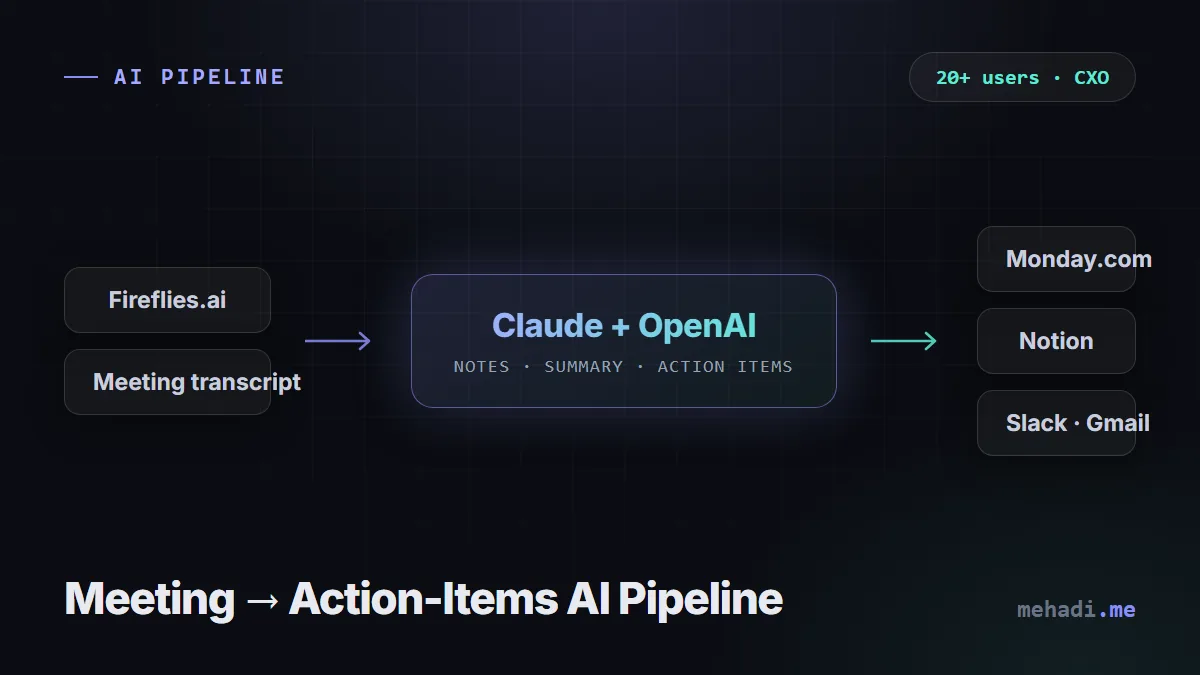
AI · Workflow Orchestration
Meeting → Action-Items AI Pipeline
Transcripts become notes, summaries, and owner-assigned action items on the right task board, automatically.
- Rolled out to 20+ internal users across teams and CXOs
- Post-meeting admin and duplicate data entry sharply reduced

AI · Sales Automation
AI Follow-Up Agent for Lead Nurturing
Contextual call, SMS, and email sequences driven by AI, triggered by how each lead actually behaves.
- Every lead gets timely, personalized follow-up across three channels
- Sales team freed from manual sequence management

AI · Research Automation
STR Compliance Research Automation
Source-cited compliance reports generated automatically with Perplexity: research that took hours now takes minutes.
- Manual research time reduced dramatically, from hours to minutes
- Every report is source-cited and consistently formatted
How it works
From first call to running system
-
01
Free 30-min audit
You walk me through the manual process. I tell you honestly whether automation makes sense and roughly what it involves.
-
02
Fixed-scope proposal
If it is a fit, you get a written scope, timeline, and price before any work starts. No obligation.
-
03
Build and test
I build with error handling, retries, and alerting from day one, and test against your real data and edge cases.
-
04
Handover and support
You get documentation and a walkthrough, plus optional maintenance for when sites, APIs, or credentials change.
Good to know
Questions about AI Agents & LLM Integration
Which model do you use, OpenAI or Claude?
Whichever does the specific task best at a sensible cost. In production I have used Claude and OpenAI side by side in the same pipeline, and routed through OpenRouter when a client wanted flexibility. The workflow is built so the model can be swapped without a rebuild.
How do you stop the AI from making things up?
By giving it narrow jobs with structured outputs, validating what comes back, grounding research in cited sources, and routing anything uncertain to a person. LLMs handle the judgment steps; ordinary code handles the rules.
Can you add AI to the tools we already use?
Yes, that is most of the work. AI steps are added inside your existing automation and write into the systems your team already uses, rather than forcing a new platform on everyone.
What about data privacy?
We decide up front what data the model may see, use API access rather than consumer chat apps, and keep credentials in your own accounts. If data cannot leave your infrastructure, we can scope around that before building.
Tell me what's eating your team's hours
Describe the manual process and the tools involved. I'll reply within 24 hours with an honest take on whether automation can fix it, what it would involve, and what it would cost.