Case Study · AI · Workflow Orchestration
n8n Workflow: Meeting Transcripts → Assigned Action Items
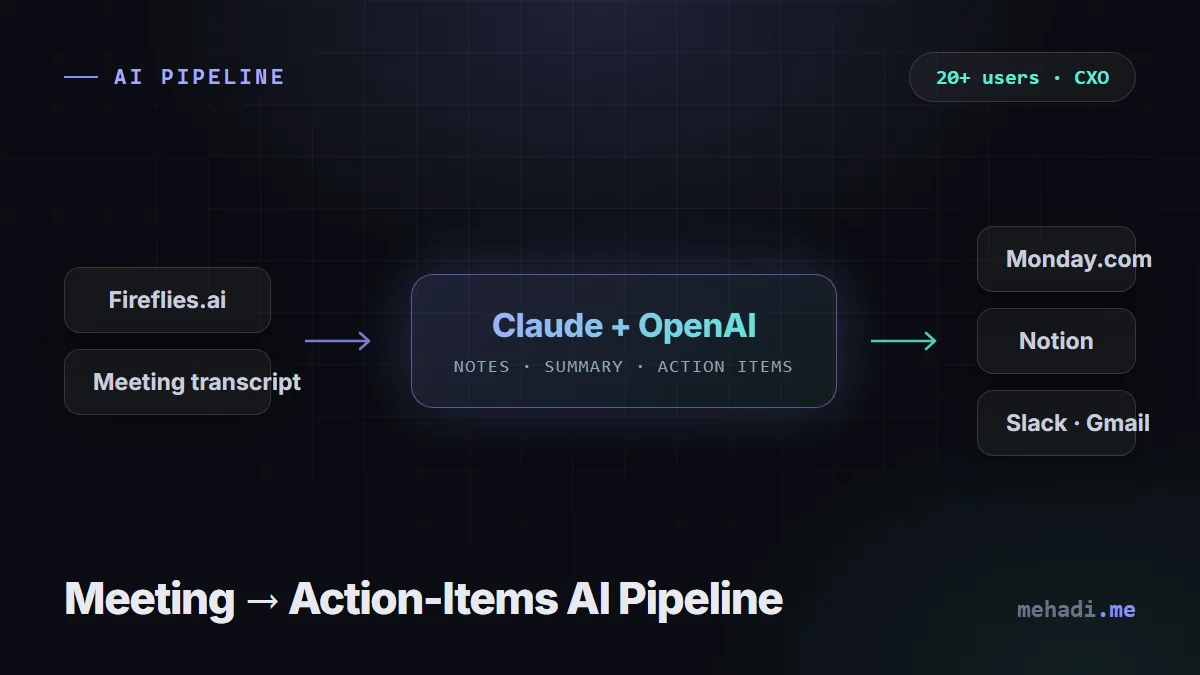
Fireflies.ai transcripts flow through Claude and OpenAI into owner-assigned tasks on the correct Monday.com board, with summaries delivered to Notion, Gmail, and Slack before the meeting room empties.
- 20+
- daily users, incl. CXOs
- 100%
- of recorded meetings processed
- 0
- manual triage steps per meeting
Client context
A fast-growing, meeting-heavy organization of 20+ people (spanning delivery teams, project managers, customer success, and the executive suite) recorded its calls with Fireflies.ai. The recordings were faithful; what happened after them was not.
As the AI automation lead on this rollout, I owned the pipeline from transcript ingestion to task creation, and drove adoption across every team.
The problem
After every meeting, someone had to do the invisible work: re-listen or skim the transcript, write up notes, pull out the action items, figure out which project board each item belonged to, create the tasks, and assign owners. Multiply that by several meetings a day across teams and the post-meeting admin added up to hours of duplicated effort, every day.
Worse than the cost was the leakage. Action items agreed verbally never made it to a board; items landed on the wrong board; tasks were created but never assigned. Decisions evaporated between the call ending and someone finding time to document it.
The automation I built
I built and deployed an n8n workflow that makes the transcript the trigger and the assigned task the output, with no human in between. The key workflow logic:
- Transcript ingestion: when Fireflies.ai finishes processing a recorded meeting, n8n picks up the transcript automatically: every meeting, no opt-in step.
- LLM processing: Claude and OpenAI turn the raw transcript into three artifacts: structured notes, an executive summary, and a list of discrete action items with owners and context.
- Board routing by meeting name: the workflow maps each meeting to the correct Monday.com task board using the meeting's name, so a client-project call files its items on that client's board and an internal ops call files elsewhere, automatically.
- Owner assignment: each action item is matched to the right team member and assigned on Monday.com, not just dumped as an unowned list.
- Multi-destination delivery: notes and summaries post to Notion for the knowledge base, email recaps go out via Gmail, and Slack notifies the relevant channel: everyone gets the outcome in the tool they already watch.
Quantified outcome
The workflow was rolled out to 20+ internal users across teams and the CXO level, and it changed what "end of meeting" means: by the time people are back at their desks, the tasks already exist, on the right board, with the right owners.
- Post-meeting admin was sharply reduced across every team: the re-listen, write-up, and task-creation routine is gone.
- Duplicate data entry eliminated: one pipeline writes to Monday.com, Notion, Gmail, and Slack from a single source of truth.
- Action-item leakage stopped: 100% of recorded meetings are processed, and every extracted item lands assigned on the correct board.
- Executives get consistent, skimmable summaries of every meeting without asking anyone to write them.
Stack
Have a process like this eating your team's hours?
Tell me about it. I'll reply within 24 hours with an honest take on whether automation can fix it, what it would involve, and what it would cost.
Book a free 15-min automation audit