Comparison · Blog Post
OpenClaw vs n8n: When an AI Agent Should Run Your Business Process, and When It Should Not
"openclaw vs n8n" became one of the fastest-rising n8n searches on Google this year, and the question behind it is reasonable. If an AI agent can read your email, open your files, and act on your behalf from a chat message, why build workflows at all? I build production automations for a living, most of them in n8n with Claude or OpenAI inside. My answer is that they solve different problems, and the businesses that get the most out of AI use both, in a specific way.
By Mehadi Hasan 8 min read
1. Two different kinds of tool
OpenClaw: a personal agent that decides what to do
OpenClaw is a free, open-source autonomous AI agent created by Peter Steinberger, previously known as Clawdbot and Moltbot. It runs on your own machine or server, talks to you through messaging apps, and can read your files and act on your behalf (OpenClaw guide). You give it a goal in plain language, and a language model works out the steps. Its abilities grow by installing skills, many of them from the community hub ClawHub.
n8n: a workflow engine that does what you designed
n8n runs workflows you design in advance: a trigger, then defined steps across your systems, with branches, retries, and error handling. AI can be one of the steps, for example a model that classifies an email or drafts a reply, but the path is fixed, logged, and the same every time. You can self-host it or use n8n Cloud.
Put simply, an agent is improvisation, and a workflow is a process. Businesses need both, but not for the same jobs.
2. Where an agent like OpenClaw shines
- One-off and varied tasks. "Find last quarter's invoices from this supplier and summarise what changed." No two requests are the same, so there is nothing worth building a workflow for.
- Personal productivity. Inbox triage, research, drafting, and reminders for one person, on that person's own accounts.
- Exploring a process before you formalise it. Letting an agent do a task by hand a few times is a fast way to learn what the real steps and exceptions are.
3. Why an autonomous agent is risky as a business process
Prompt injection is not solved
An agent that reads email and web pages can be steered by text hidden in them. OpenClaw's creator has said plainly that prompt injection is unsolved, and its security guidance warns against weaker models that are easier to manipulate (interview transcript). An agent with access to customer data and payment systems is a large target.
The skill supply chain has already been attacked
In February 2026, researchers who audited 2,857 skills on ClawHub found 341 malicious ones, most from one campaign that installed an information stealer (The Hacker News). A separate Snyk study found critical security issues in 13.4% of the skills it scanned (Snyk). ClawHub has since tightened who can publish, but an installed skill still runs with the agent's access.
Same input, different result
A model choosing its own steps can take a different path tomorrow than today. For invoicing, onboarding, or CRM updates, "usually right" is not good enough. You need the same steps every time and a log that shows what happened.
It belongs to a person, not the team
A personal agent runs with one person's logins on one person's machine. When they are on holiday, or leave, the "process" leaves with them. There is no shared view of runs, no retry queue, and no alert to the team when something fails.
4. What n8n gives a business process that an agent does not
- Triggers that do not need a person. Webhooks, schedules, new emails, form submissions, and board changes start work at 3am without anyone asking.
- Every run recorded. You can open any execution and see exactly what came in, what each step did, and what went out.
- Errors handled on purpose. Retries with backoff, error workflows, and alerts to Slack, so failures are noticed. I cover this in making n8n workflows production-ready.
- Credentials scoped to the job. Each workflow uses the specific accounts and permissions it needs, owned by the business, not a person.
- Predictable cost. A model is called only at the steps that need judgement, not for every click.
5. The pattern that works: AI inside the workflow, workflows as the agent's tools
You do not have to choose. The setups I build combine both, in two directions:
- AI as a step in a fixed process. The workflow owns the path, and a model handles the parts that need judgement: reading a document, classifying a request, extracting action items, drafting a reply. Its output goes into a fixed schema and is checked before anything is written. My meeting notes to action items pipeline works this way: Claude and OpenAI read the transcript, and n8n routes each action item to the right monday.com board, for 20+ users.
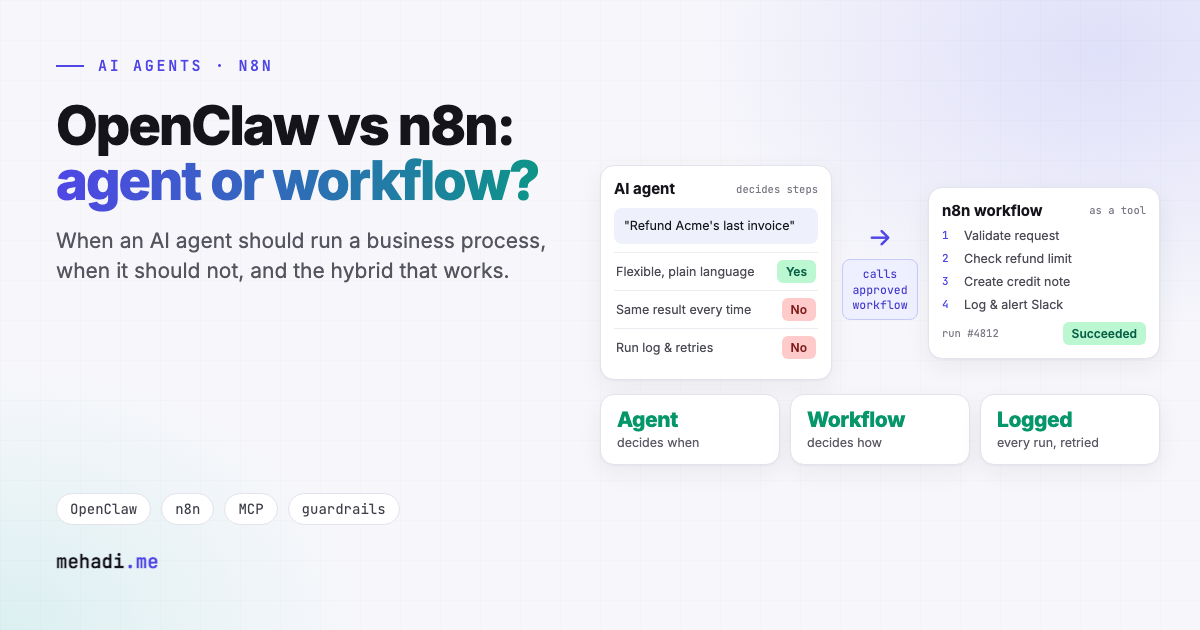
- Workflows as safe tools for an agent. n8n can act as an MCP server, so an agent such as Claude can call specific, approved workflows as tools (n8n MCP Server Trigger). The agent decides when to "create a client" or "issue a refund request", but the workflow decides how, with validation, logging, and limits. The agent never gets raw access to your systems.
This gives people the flexibility of asking in plain language, and gives the business the control of a designed process.
6. A quick way to decide
- Happens more than a few times a week, the same way: a workflow.
- Touches money, customer data, or other people's work: a workflow, with AI only at checked steps.
- Different every time, for one person, low risk: an agent.
- People want to ask in plain language, but the action must be safe: an agent that calls workflows as tools.
If you do run an agent like OpenClaw at work, give it its own accounts with the least access it needs, install only skills you have read, keep it away from payment and admin rights, and keep a human approval step for anything that cannot be undone.
Not sure whether you need an agent or a workflow?
Describe the process you want to automate: what triggers it, what systems it touches, and what goes wrong today. I will reply within 24 hours with whether it suits an agent, a workflow, or both, and roughly what it takes. See my n8n automation service and AI agent development.
Get a free 30-min automation auditFrequently asked questions
Is OpenClaw a replacement for n8n?
Not for business processes. OpenClaw is a personal autonomous agent that decides its own steps, which suits varied one-off tasks. n8n runs designed workflows with triggers, logs, retries, and scoped credentials, which suits processes that must run the same way every time.
What are the security risks of AI agents like OpenClaw?
Prompt injection, which OpenClaw's creator has said is unsolved, and malicious skills: in February 2026 researchers found 341 malicious skills among 2,857 audited on ClawHub. Run agents with their own least-privilege accounts, install only skills you have read, and keep a human approval step for irreversible actions.
Can an AI agent use n8n workflows?
Yes. n8n's MCP Server Trigger exposes selected workflows as tools to MCP clients such as Claude. The agent decides when to call a workflow, and the workflow controls how the action is done, with validation and logging.
When should I use an agent instead of a workflow?
Use an agent for varied, low-risk tasks for one person. Use a workflow for anything that repeats, touches money or customer data, or affects other people's work. Combine them when people want to ask in plain language but the action must be safe.
Facts checked November 3, 2026 against the sources linked above. OpenClaw and n8n both change quickly; check current documentation and security advisories before you deploy either.